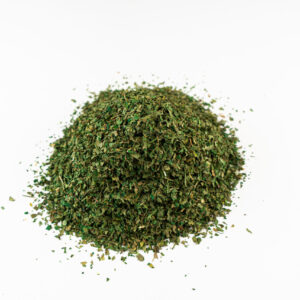

- Product Name: Dried Molokhia Leaves
- Family: Malvaceae
- Botanical Name: Corchorus olitorius
- Common Names: Dried Molokhia leaves | Jute Mallow | Dried Mallow | Jute Leaves | Lalo | Egyptian Molokhia
- Cultivation: Conventional; supplied without additional laboratory testing.
- Plant Part: Leaf
- HS Code: 0712.90
- MOQ: 3.50 MT — FCL 40″
- Origin: Egypt
- Crop: July – Sep.
Trusted Dried Molokhia Leaves Exporter in Bulk for Global Importers
Introduction
Source your next container of dried molokhia leaves directly from Egypt — available as Leaves or Crushed, hand-sorted by skilled labor and prepared to meet your exact specifications for food manufacturing, instant soup production, or private-label packing.
Molokhia is one of the few dried leaf products where the buyer’s quality assessment happens in the pot. What matters is how the leaf behaves when rehydrated: the characteristic body and rich mucilage viscosity that molokhia soup depends on, and a deep green colour that survives cooking rather than turning olive.
Both come down to handling. Our leaves are hand-sorted by an experienced family-run team — three generations in the Egyptian agricultural sector — to ensure consistent quality, vibrant colour, and full leaf integrity across every shipment.
We supply container-ready shipments worldwide, backed by full export documentation and optional third-party inspection.
Request a Quote | Ask for a Sample | Discuss Your Specifications
Available Forms
Choose the form that best matches your processing requirements:
Leaves Molokhia — intact dried leaf, the traditional format. Preferred by buyers who chop or process in-house and by private-label packers serving households that prepare it traditionally.
Crushed Dried Molokhia — ready-to-use format for food manufacturers, instant soup producers and frozen food processors running rehydration lines. Crushed molokhia is widely imported into Japan and South Korea as a functional food and dietary supplement ingredient, where consistency of grind and colour matters particularly.
EIC Quality & Certifications
We stand behind the quality of our dried molokhia leaves because we build long-term supply partnerships.
For independent verification, we accept optional third-party inspection by SGS or another inspection company of your choice, at the buyer’s expense.
Our certificates and registrations include:
- NFSA registered with the Egyptian Food Safety Authority
- ISO 9001 & ISO 22000 certified for quality and food safety management
- FDA, DUNS, GACC (China), and MFDS (Korea) registered
View our certificates and registrations for support with import compliance.
Quality controls: hand sorting by an experienced team to maintain leaf integrity and remove defective material; colour and uniformity grading; cleaning to remove stems, dust, and foreign matter; cutting to your specified format; and moisture verification before packing.
Produced and handled according to international food safety and import requirements, suitable for customs clearance and routine border inspections in global destination markets.
Beyond certificates, we rely on our family experience and reputation. Our roots in the herb trade go back to 1960, beginning with our grandfather. We protect that reputation with every shipment and seek lasting relationships with importers.
Shipping, Export Coordination & Documentation
Shipping & Logistics:
- FOB, CFR, and CIF Incoterms, with loading from Port Said, Alexandria, Damietta, and Sokhna ports
- Predictable monthly shipments and long-term contract options
- Cost-effective shipping arrangements through our freight partners
Export Documentation:
- Commercial Invoice & Packing List
- Certificate of Origin (COO), issued for the destination market
- Official Phytosanitary Certificate
- Bill of Lading (BL)
- Fumigation Certificate to prevent insect risks
- War Risk Insurance for 40′ containers, covered by EIC
Silica gel is applied inside containers for humidity control, protecting the quality of the dried molokhia leaves (Jute leaves) during transit.
Our responsibility goes beyond loading at the port of origin. We act as long-term B2B supply partners, remaining accountable for the quality of your bulk jute leaves through transit and upon arrival.
Packaging, Shelf Life & Storage
Packing Configurations:
- 5 kg carton
- 100 g / 200 g / 400 g plastic sacks inside carton — for private-label packers requiring retail-ready inner units
- Customized B2B packing available on request
Shelf Life: Confirm — typically 24 months under recommended conditions.
Storage Conditions: Store Dried Mallow (Lalo) in a cool, dry environment, protected from direct sunlight and humidity. Light fades the green colour, so packaging integrity matters more than the calendar date.
Supply Capacity & What Affects Molokhia Price
Supply Capacity:
- MOQ: 3.50 MT — FCL 40″. Dried molokhia leaf is extremely low density, so a container reaches its volume limit far before its weight limit. 3.5 MT in a 40′ is normal for this product and worth explaining to first-time buyers.
- Predictable monthly shipments
- Long-term contract options to guarantee stable supply
- Consolidation available — molokhia can ship alongside other leaf herbs and dried vegetables in one container
What Affects Molokhia Price:
- Leaf integrity and stem content. Hand sorting to maintain-leaf integrity costs throughput; stem dilutes both colour and value per kilo.
- Product form. leaf and crushed are priced separately.
- Packing configuration. Retail-ready inner sacks cost more to prepare than bulk cartons.
- Order volume and contract term
- Timing of the Order Relative to the Crop: Ordering Jute leaves during the harvest period gives access to fresher molokhia with stronger natural green colour and a more pronounced aroma. Learn about the harvest time
Because molokhia prices vary with these factors, we quote each shipment individually rather than publish a fixed rate. For better planning, check our Egyptian Herbs, Spices, Seeds & Legumes Harvest Calendar to understand seasonal timing. Send us your specifications and destination port for an accurate quotation within 24 hours.
Who This Product Is For
Our dried molokhia leaves (Lalo) supply is intended for B2B clients purchasing at container scale for manufacturing, processing, and commercial use.
- Jute Leaves → Dry food packers producing Middle Eastern and North African private label; ethnic grocery distributors
- Crushed Molokhia → Instant soup manufacturers; frozen food processors running rehydration lines; functional food and dietary supplement manufacturers in Japan and South Korea
- Both forms → Food service and catering suppliers; West African market suppliers requiring lalo
Prepared for long-term contracts rather than spot or retail orders, with a focus on stable quality, uniform leaf integrity, and shipment consistency.
We supply container-scale quantities to commercial buyers and do not serve retail or direct-to-consumer sales.
Request a Quote or Sample
- Specify the molokhia format required — Molokhia Leaves or Crushed Molokhia — based on your market needs.
- Define shipment scale and preferred delivery port to align with your import planning.
- Receive a tailored export offer reflecting packing method, volume, and loading schedule.
- Move forward with sampling validation — through a factory visit, a video showing the actual molokhia sample, third-party inspection such as SGS, or a physical pre-shipment sample.
- Confirm your first full-container order once the specifications and sample are approved.
Request a Commercial Offer for Dried Jute Leaves
info@herbseic.com | www.herbseic.com | WhatsApp Us Now| Based in Fayoum, Egypt.
Fast response within 24 hours
FAQs
Who are we?
We are a third-generation family business established in 2007, with family roots in the herb trade going back to 1960. We process our products in two facilities: manual processing for delicate products and mechanized sorting and processing.
What are jute leaves, and are they the same as molokhia?
Yes — same plant, Corchorus olitorius. “Molokhia” is the Arabic name, “jute mallow” or “jute leaves” is the English trade name, and “lalo” is the West African name, particularly in Mali and Senegal. The leaf is used in soups, stews, and sauces across all these cuisines.
Should I order crushed leaf?
leaf suits buyers who chop in-house and private-label packers selling to households preparing it traditionally. Crushed is ready to use for food manufacturers, instant soup producers, and rehydration lines. Tell us the application, and we will recommend.
How many tons of dried jute leaves are loaded in a 40′ container?
Dried molokhia leaves are normally packed in 5 kg cartons, with 700 cartons per 40′ container, giving a total load of approximately 3,500 kg (3.5 MT).
Can you supply retail-ready inner packing?
Yes. We pack 100 g, 200 g, and 400 g plastic sacks inside cartons for private-label packers who need retail-ready units. The product itself is still supplied at container scale for B2B buyers rather than sold directly to consumers.
Can you supply to a specific regional market?
Yes. Cut format, packing size, and labelling preferences differ between Levantine, Gulf, East Asian, and West African markets — tell us which you supply, and we will advise on the format your customers expect.
Do you seek long-term relationships with buyers?
Yes. We serve customers across 21 countries spanning the Americas, Africa, Europe, Asia, the Gulf region, and Australia. We want every first shipment, and every shipment that follows, to strengthen trust and build a lasting partnership.
Do you work with brokers or commission-based agents?
No. We do not work with brokers or commission-based intermediaries. We deal directly with the consignee and the actual buyer.
How can I verify and follow my order before shipment?
You can verify your order through a factory visit, video verification, or a third-party inspection (such as SGS) at the buyer’s expense. You can also follow your shipment through our export process. Explore Our Process
Do you supply the local market?
No. We supply export markets only.