
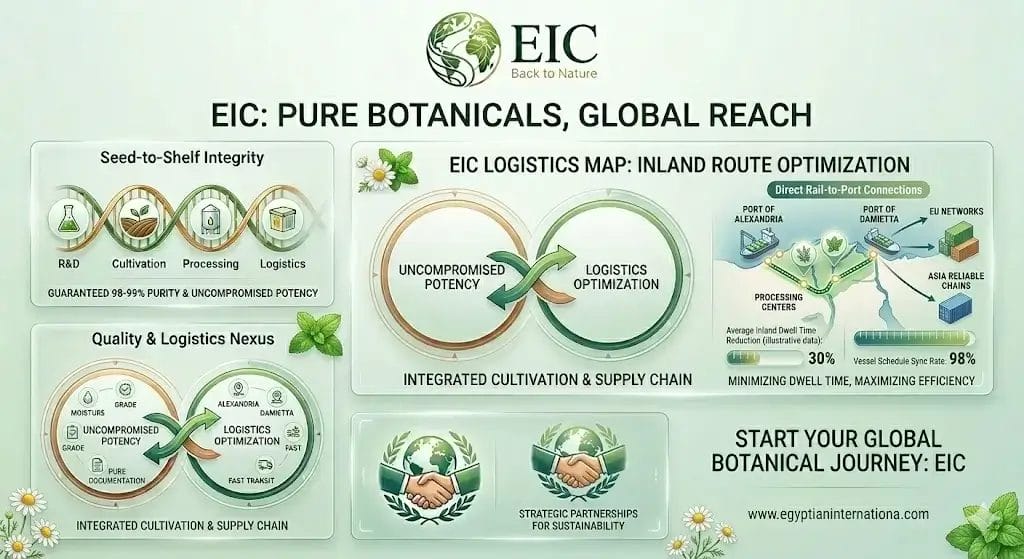
In the high-velocity world of international trade, the choice of departure point is just as critical as the quality of the crop. For procurement managers and food scientists, sourcing from Egyptian herb suppliers involves more than evaluating leaf grade; it requires a deep understanding of Egypt export ports and their impact on product integrity. The journey from the fertile Nile Delta to an international manufacturing facility depends on port logistics, container handling speeds, and transit times. At Egyptian International Center for export, we leverage the strategic advantages of both the Port of Alexandria and the Port of Damietta to ensure our botanical exports reach global markets with 98-99% purity and uncompromised potency.
The Landscape of Egypt Export Ports in Agribusiness
Egypt serves as the Mediterranean’s primary gateway for agribusiness exports, offering multiple maritime hubs that connect the Middle East to Europe, Asia, and the Americas. However, not all Egyptian export ports are created equal when it comes to the sensitive requirements of wholesale botanical cargo.
Selecting between the Port of Alexandria and the Port of Damietta—two of the busiest Egypt export ports—is a strategic decision based on shipping line availability and customs efficiency.
- Shipping line availability for specific global routes.
- Customs efficiency and specialized agricultural inspections.
- Proximity to the harvesting hubs of the Nile Delta.
- Available infrastructure for FCL shipping and moisture-controlled storage.
The Port of Alexandria: The Historical Gateway for Herbs
As the nation’s oldest and largest maritime hub, the Port of Alexandria remains a cornerstone for Egyptian herb suppliers. It handles over 60% of Egypt’s foreign trade, making it a powerhouse for port logistics.
Advantages for Botanical Sourcing
The Port of Alexandria is often the preferred choice for Chamomile exports and other high-volume herbs due to its massive shipping line availability. Most major carriers have daily departures to European hubs, ensuring a reliable supply chain with minimal dwell time. Furthermore, the port has established dedicated lanes for agricultural products, improving customs efficiency for time-sensitive materials.
Logistical Considerations in Egypt export ports
Because it is a bustling urban port, land-side congestion can occasionally impact transit times for inland trucking. However, for large-scale industrial applications, the sheer volume of containers moving through Alexandria ensures competitive freight rates and consistent equipment availability.
The Port of Damietta: The Modern Alternative
For many modern Egyptian herb suppliers, the Port of Damietta has emerged as a high-tech alternative to Alexandria. Located roughly 70km west of the Suez Canal, it offers a distinct set of advantages for agribusiness exports.
Why Damietta Excels in Egypt export ports Logistics
- Modern Infrastructure: Damietta features some of the most advanced automated container terminals in the region, which significantly boost customs efficiency.
- Direct Access to the East: Its proximity to the Suez Canal makes it an ideal choice for shipments heading to Asian or Middle Eastern markets.
- Storage and Preservation: The port offers expansive, modern warehousing facilities that are essential for maintaining the 98-99% purity of botanicals during peak harvest seasons.
Comparing Transit Times and Shipping Line Availability
For a procurement manager, the “Lead Time” is the ultimate metric. A reliable supply chain in Egypt export ports depends on the predictability of vessel departures and arrivals.
| Feature | Port of Alexandria | Port of Damietta |
| Primary Markets | Europe & North America | Asia & Gulf Region |
| Shipping Line Availability | Exceptional (All Major Lines) | High (Strong Focus on Feeders) |
| Customs Efficiency | High (Experienced with Herbs) | Very High (Modern Digital Systems) |
| Transit Times to the EU | 4–7 Days | 6–9 Days |
Quality Assurance from Field to Vessel
Regardless of the chosen port, Egyptian herb suppliers must uphold rigorous quality assurance standards. At the Egyptian International Center for Export, our direct sourcing model ensures that the herbs are processed and packaged to survive the specific environmental conditions of each port.
- Moisture Control: We verify that the moisture content is optimized for the humid Mediterranean air characteristic of major Egypt export ports. Furthermore, we strategically place white silica gel desiccant bags inside the container during the loading process at our factory. This proactive measure allows us to maintain precise control over moisture levels, ensuring the premium quality of our bulk herbs, pulses, and seeds throughout the transit (TT).
- Container Grading: We only utilize “Food Grade” containers, ensuring that the 98-99% purity of our botanical exports is never compromised by the structural integrity of the shipping equipment.
- Documentation Synchronization: We manage all international food safety certificates and export permits in-house to ensure seamless movement through port security.
About the Company: EIC for export
The Egyptian International Center for Export, known in the industry as EIC for export, is a premier leader in the Egyptian botanical sector. For decades, the Egyptian International Center for Export has mastered the intersection of agriculture and maritime logistics. By maintaining deep operational ties with both the Port of Alexandria and the Port of Damietta, we provide our global partners with an unparalleled, reliable supply chain. Our expertise as leading Egyptian herb suppliers is backed by a commitment to direct sourcing and quality assurance, ensuring that every ton of product we export meets the most stringent international standards for purity and safety.
Egypt export ports: Optimizing Your Logistics Strategy
Strategic port selection is a vital component of successful botanical procurement. While the Port of Alexandria offers unmatched shipping line availability and historical expertise, the Port of Damietta provides modern customs efficiency and specialized infrastructure. As top Egyptian herb suppliers, Egyptian International Center for export manages this complexity on behalf of our clients, selecting the optimal gateway to minimize transit times and maximize product integrity.
Elevate your agribusiness exports with the experts in Egyptian logistics.
Contact EIC for export today for a Wholesale Quote or to discuss a Strategic Partnership. Discover the advantages of direct sourcing and the 98-99% purity standards that only the Egyptian International Center for export can provide.
Frequently Asked Questions (FAQ)
Which Egypt export ports is better for North American shipping?
The Port of Alexandria is generally considered superior for North American shipping. Due to its massive shipping line availability, it offers more frequent direct and transshipment services to major East Coast ports (like New York and Savannah). This helps in reducing overall transit times and ensures a more consistent flow for your reliable supply chain.
What are the lead times for the Port of Alexandria?
Lead times for the Port of Alexandria vary based on the destination. For Southern European ports, transit is typically 4 to 7 days. For Northern Europe, it ranges from 10 to 14 days. When factoring in customs efficiency and inland transport from our facilities, EIC for export usually advises a total lead time of 14 to 21 days from order confirmation to vessel departure for most botanical exports.