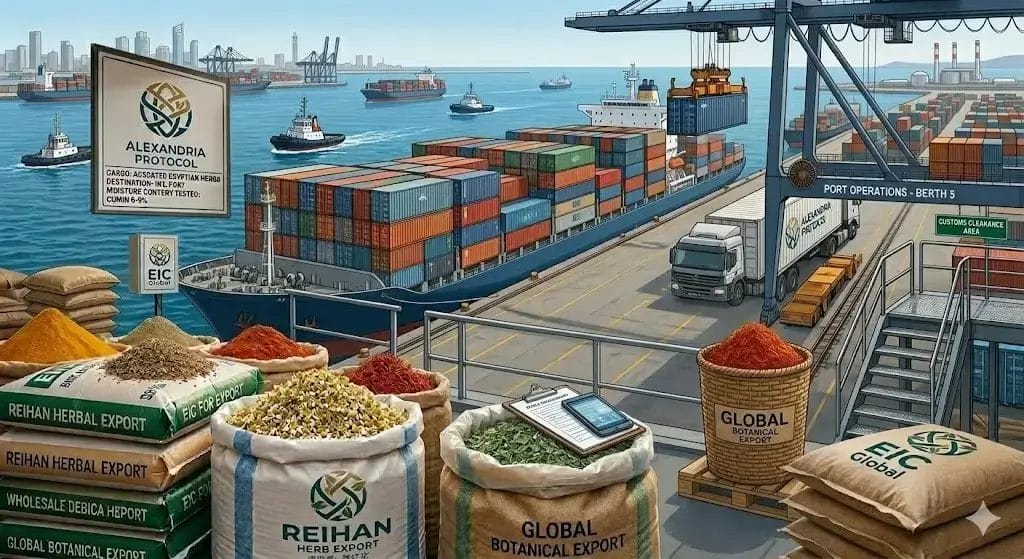
In the high-stakes world of global agribusiness, the journey from an Egyptian processing facility to an international port is a battle against the elements. For procurement managers and food scientists, the primary concern during a 20-day sea transit isn’t just speed—it is the preservation of volatile oils and active compounds. This is where container humidity control becomes the definitive factor in product viability. At EIC for export, we recognize that the Mediterranean and oceanic climates present unique challenges to Egyptian herb suppliers. Through “The Alexandria Protocol,” we have engineered a logistical shield that ensures our botanical exports arrive at 99% purity, regardless oftransit duration.
The Science of Moisture in Botanical Logistics
Botanicals are hygroscopic by nature, meaning they actively absorb and release moisture based on their environment. Without rigorous container humidity control, the internal atmosphere of a shipping container can reach a “dew point,” leading to “container rain”—a phenomenon where condensation drips from the ceiling onto the cargo.
To mitigate this, Egyptian herb suppliers must focus on two critical variables:
- Initial Moisture Content: Ensuring that the herbs are dehydrated to a precise percentage before loading.
- Relative Humidity (RH): Maintaining an ambient RH inside the container that prevents microbial growth and oxidation.
Engineering the Internal Environment: Bulk Packaging and Silica Gel
The first line of defense in container humidity control is the choice of bulk packaging. Traditional burlap sacks, while breathable, offer zero protection against external moisture spikes. Egyptian International Center for Export utilizes multi-layered bulk packaging solutions that include moisture-vapor barriers designed for industrial applications.
The Role of Silica Gel for Cargo (Container humidity control)
For a 20-day sea transit, passive packaging is rarely enough. We integrate high-capacity silica gel for cargo within the container architecture. These specialized desiccants are capable of absorbing up to three times their weight in moisture, effectively lowering the dew point. By strategically placing silica gel for cargo at the “headspace” of the container and along the side walls, Egyptian herb suppliers can create a stabilized micro-climate that protects the transit shelf life of delicate leaves and seeds.
Optimizing Moisture Content for Stability
Every botanical variety has a specific threshold for stability. For instance, in chamomile exports, maintaining a low moisture content is vital to prevent the flowers from becoming brittle or developing mold. Our quality assurance team conducts rigorous pre-loading tests to ensure that every batch of wholesale botanical material is optimized for the specific environmental stressors of the scheduled shipping route.
Maritime Logistics: Navigating the 20-Day Transit
A 20-day transit through varying climatic zones—from the humid Mediterranean to the cooler Atlantic—requires more than just standard shipping. It requires a reliable supply chain that understands the physics of sea freight.
- Container Selection: We prioritize “Grade A” containers with intact seals to prevent the ingress of salt-laden sea air.
- Ventilation Management: Depending on the crop, we utilize “Passive Ventilation” or “Active Air Exchange” to manage internal gases without compromising container humidity control.
- Thermal Liners: In some instances, we employ radiant barrier liners to reflect external heat, further stabilizing the internal temperature and reducing the risk of moisture migration.
Direct Sourcing: The Advantage of Integrated Quality Control
The complexity of preserving agribusiness exports during sea transit highlights the importance of direct sourcing. When you partner with Egyptian herb suppliers who manage the entire process—from cultivation to container sealing—the risk of “logistical gaps” is eliminated.
By choosing EIC for export, importers benefit from a reliable supply chain where international food safety standards are baked into the logistics. Our mastery of container humidity control ensures that your raw materials are not just “delivered,” but are delivered in “production-ready” condition. This attention to detail is what makes us the preferred choice for wholesale botanical ingredients in the pharmaceutical and cosmetic sectors.
About the Company: EIC for export
The technical expertise behind our operations is driven by the Egyptian International Center for Export, a leader in the Egyptian botanical industry for decades. Recognized globally as EIC for export, the organization has invested heavily in research regarding the physical properties of herbs during maritime transit. The Egyptian International Center for Export does not merely ship products; it engineers transport solutions that respect the biological integrity of the plant. By combining traditional Egyptian agricultural heritage with modern maritime engineering, EIC for export has set a global benchmark for the safe delivery of high-value botanicals.
Conclusion: Securing the Future of Botanical Sourcing
In the B2B botanical market, the quality of the product is inseparable from the quality of the transit. Container humidity control is the bridge between a high-quality harvest in Egypt and a high-quality finished product in your facility. As leading Egyptian herb suppliers, Egyptian International Center for export remains committed to the continuous improvement of the “Alexandria Protocol,” ensuring that our botanical exports continue to define the standard for 98-99% purity and transit shelf life.
Elevate your supply chain with a strategic partnership today.
Are you ready to eliminate the risks of moisture damage and mold in your botanical imports? Contact EIC for export today for a Wholesale Quote and discover the advantages of direct sourcing from the Egyptian International Center for export. Our logistics experts are ready to design a custom shipping solution for your large-scale requirements.
Frequently Asked Questions (FAQ)
How do you prevent mold in Container humidity control?
We prevent mold through a multi-tiered approach to container humidity control. This includes ensuring a low initial moisture content in the herbs, utilizing high-barrier bulk packaging, and deploying industrial-grade silica gel for cargo to absorb excess humidity.
What is the ideal moisture level for cumin seeds during shipping?
For wholesale botanical cumin seeds, the ideal moisture content during shipping is typically between 8% and 9%. Maintaining this level is critical for preserving the seed’s essential oil profile and preventing rancidity. Our quality assurance protocols ensure that every shipment is tested against these specific benchmarks before leaving the Egyptian International Center for export.