In the sophisticated realm of global trade, the language of logistics is written in three-letter codes. For procurement managers and global importers, mastering Incoterms for agricultural export is not just a legal necessity—it is a cornerstone of financial optimization. When sourcing from Egyptian herb suppliers, the choice between FOB, CIF, or CFR can significantly impact your bottom line, your risk profile, and your reliable supply chain. At Egyptian International Center for export, we believe that transparency in shipping terms is as vital as the 98-99% purity of our products. This guide provides a deep dive into selecting the right Incoterms to ensure your botanical exports are handled with the professional precision they deserve.
The Strategic Importance of Incoterms for agricultural export
Incoterms (International Commercial Terms) define the responsibilities of buyers and sellers regarding the delivery of goods under sales contracts. In the context of agribusiness exports, these terms dictate who handles the inland transport, who manages the customs at the Port of Alexandria, and at what exact point the risk of loss transfers from the supplier to the importer.
For a food scientist or cosmetic chemist, the primary goal is to receive raw materials in pristine condition. However, for the procurement department, the goal is clarity on shipping risk transfer. Choosing the right Incoterms for agricultural export ensures that there are no “hidden” costs or jurisdictional disputes during the voyage.
FOB Alexandria: The Importer’s Control Model
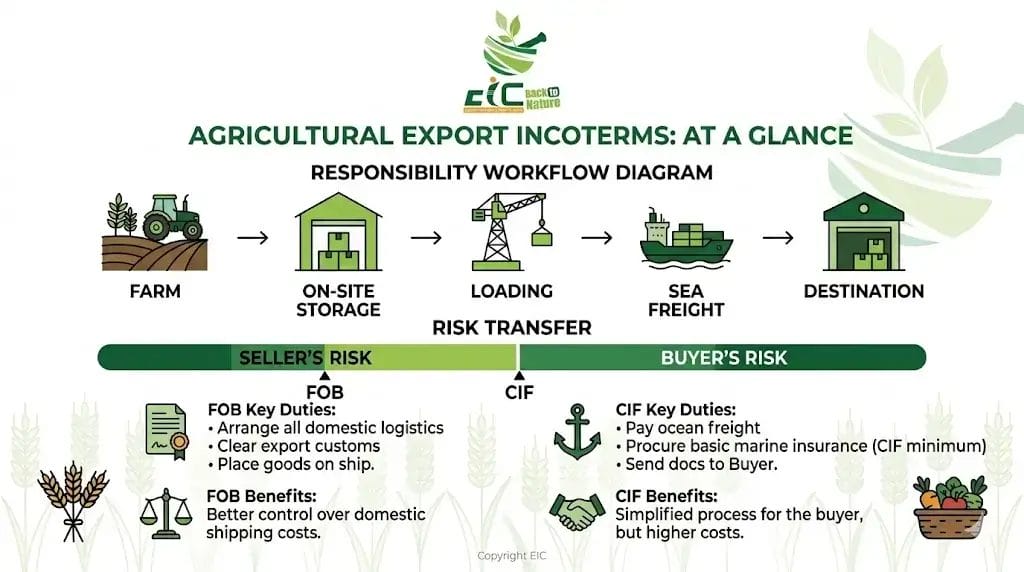
FOB Alexandria (Free on Board) is one of the most common terms used by seasoned importers when dealing with Egyptian herb suppliers. Under FOB terms, the seller is responsible for all costs and risks until the goods are loaded onto the vessel at the designated port.
Advantages of FOB for Global Importers
- Freight Control: The buyer chooses the shipping line and negotiates the freight rates directly, allowing for better integration into their existing reliable supply chain.
- Cost Transparency: By separating the product cost from the shipping cost, importers can more easily compare wholesale botanical prices across different regions.
- Direct Logistics Management: You have total control over the transit time and the choice of FCL shipping or LCL, ensuring the industrial application of your herbs isn’t delayed by a third-party carrier.
The Seller’s Duty in FOB
At Egyptian International Center for export, our duty under FOB Alexandria includes internal transport from our processing facility, export cleaning, and all export documentation required to clear Egyptian customs. The shipping risk transfer occurs once the botanicals safely cross the ship’s rail.
How CIF and CFR Simplify Incoterms for Agricultural Export
For many procurement managers, especially those new to direct sourcing from Egypt, understanding the right Incoterms for agricultural export such as CIF pricing (Cost, Insurance, and Freight) or CFR (Cost and Freight) offers a “turnkey” solution.
Understanding CIF Pricing
In a CIF contract, the seller pays for the freight and export insurance to deliver the goods to the destination port. This is often preferred by companies that do not have strong relationships with shipping lines operating in the Mediterranean.
- CFR (Cost and Freight): Similar to CIF, but the buyer is responsible for procuring their own export insurance.
- CIF (Cost, Insurance, and Freight): The seller provides a minimum level of insurance coverage. This is often a requirement for LC (Letter of Credit) payments to ensure quality assurance is backed by financial protection.
Why Importers Choose CIF from Egypt
Choosing CIF from reputable Egyptian herb suppliers allows you to leverage the supplier’s local volume discounts. Utilizing these specific Incoterms for agricultural export ensures that because Egyptian International Center for export moves a high volume of chamomile and other botanicals, we can often secure better pricing than an individual importer could negotiate alone.
Shipping Risk Transfer and Quality Assurance
A common misconception in Incoterms for agricultural export is that the “point of payment” is the same as the “point of risk.” In both CFR and CIF, the risk transfers to the buyer as soon as the goods are loaded on the ship in Egypt, even though the seller pays for the freight to the destination.
To protect the 98-99% purity and integrity of your botanical exports, Egyptian International Center for export implements a “Pre-Loading Inspection” protocol. Regardless of the Incoterm, we ensure:
- Container Suitability: Verification that the container is “Food Grade” and free of odors.
- Moisture Control: Ensuring the international food safety moisture levels are met before the shipping risk transfer.
- Documentation Accuracy: Ensuring all certificates follow the cargo to prevent port delays.
The Role of Export Insurance in Agribusiness
In the world of wholesale botanical trade, export insurance is the final safety net. High-value crops like Nigella Sativa or dried peppermint are sensitive to environmental shifts. When using Incoterms for agricultural export like CIF, the insurance covers the cargo against “All Risks” during the ocean voyage. This is a critical component of a reliable supply chain, providing peace of mind to food scientists and manufacturers who depend on these raw materials for their production lines.
About the Company: EIC for export
The Egyptian International Center for export, known globally as EIC for export, is a benchmark for professionalism in the botanical industry. For decades, the Egyptian International Center for Export has specialized in bridging the gap between Egypt’s rich agricultural output and the logistical requirements of the Western market. By offering flexible Incoterms for agricultural export—including FOB Alexandria, CIF, and CFR—we empower our clients to choose the model that best fits their operational strengths. Our deep understanding of international food safety and logistics mastery ensures that every contract is a blueprint for success.
Selecting the Ideal Incoterms for Agricultural Export
Choosing the right Incoterms for agricultural export is a balance between control and convenience. If you have a sophisticated logistics department, FOB Alexandria may offer the lowest total cost of ownership. However, if you seek a streamlined, insured delivery, CIF pricing provided by EIC for export ensures your botanicals are handled by experts from field to port.
Finding reliable Egyptian herb suppliers is the first step in your procurement journey; defining the terms of that journey is what secures your profit margins.
Partner with the masters of Egyptian botanical logistics. Contact EIC for export today for a Wholesale Quote or to discuss a Strategic Partnership. Let the Egyptian International Center for Export simplify your next direct sourcing contract with clear terms and world-class quality.
Frequently Asked Questions (FAQ)
What is the best Incoterms for agricultural export when importing from Egypt?
The “best” term depends on your logistics capacity. FOB Alexandria is excellent for buyers who want to control freight costs and routes. CIF (Cost, Insurance, and Freight) is ideal for buyers who want the Egyptian herb suppliers to manage the complexities of sea freight and export insurance. For most large-scale botanical exports, these two remain the industry standard.
Who pays for insurance in a CIF contract?
In a CIF contract, the seller (EIC for export) is responsible for paying the export insurance premium. This insurance protects the buyer’s interest in the goods during transit. In contrast, under CFR or FOB terms, the buyer must arrange and pay for their own insurance to cover the shipping risk transfer.