In the fast-paced world of international procurement, the efficiency of your logistics determines your market competitiveness. For procurement managers and food scientists, the decision between Full Container Load (FCL) and Less than Container Load (LCL) is not merely a logistical choice—it is a financial strategy. When sourcing from Egyptian herb suppliers, understanding the nuances of FCL export from Egypt is essential to maintaining a reliable supply chain. As the global demand for botanical exports grows, EIC for export provides the technical expertise needed to navigate these maritime decisions, ensuring that your wholesale botanical orders arrive with 98-99% purity and optimized shipping costs.
The Logistics of Excellence: Understanding FCL Export Egypt
FCL export Egypt refers to a shipment where a single importer utilizes an entire shipping container. For large-scale agribusiness exports, this is often the gold standard. When you partner with reputable Egyptian herb suppliers, the focus remains on the integrity of the cargo. FCL offers a hermetically sealed environment, shielding delicate herbs from the risks associated with consolidated cargo, such as cross-contamination or odor absorption.
Why FCL export Egypt is the Preferred Choice for Agribusiness
- Security and Purity: Because the container is sealed at the source, the quality assurance achieved during processing is locked in until it reaches your warehouse.
- Speed of Transit: FCL shipments typically move faster because they bypass the time-consuming consolidation and deconsolidation processes inherent in LCL.
- Reduced Handling: Fewer touchpoints mean a lower risk of physical damage to brittle leaves or sensitive seeds.
Analyzing Container Capacity: 20ft vs. 40ft HC
To master FCL export from Egypt, a procurement manager must understand the physical constraints and opportunities of different container sizes. The volume-to-weight ratio of botanicals varies significantly, making container selection a critical part of industrial application planning.
20ft Container Capacity
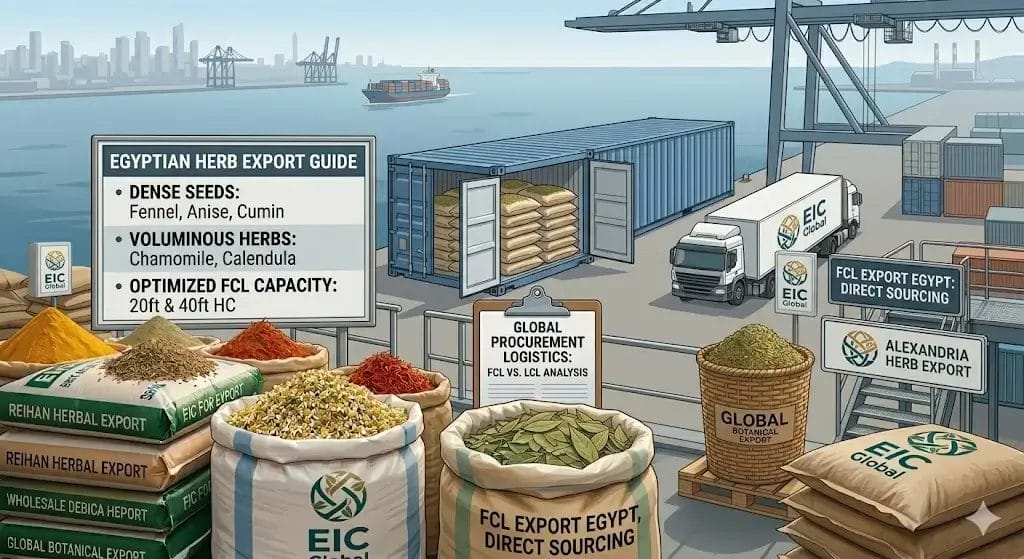
The 20ft container is the workhorse of the herb industry, especially for dense products like seeds (Fennel, Anise, Cumin).
- Volume: Approximately 33 cubic meters.
- Weight Limit: Typically handles up to 12–13 tons depending on the product and equipment.
- Strategic Use: Ideal for high-density spices where weight limits are reached before volume limits.
40ft HC Tonnage and Volume
For high-volume, low-density botanical exports like Chamomile or Calendula, the 40ft High Cube (HC) container is indispensable.
- 40ft HC Tonnage: While the weight limit is similar to a 20ft container (due to road weight limits), the volume is nearly doubled (approx. 76 cubic meters).
- Efficiency: Allows importers to ship double the amount of “fluffy” botanicals for a fraction of the extra cost, significantly lowering the per-kilogram shipping costs.
The Hidden Risks of Consolidated Cargo (LCL)
While LCL may seem attractive for smaller trials, it poses significant challenges for those prioritizing international food safety. Consolidated cargo involves sharing container space with other goods, which could include industrial chemicals, machinery, or other strongly scented products.
For a food scientist, the risk of “aromatic tainting” is too high. Direct sourcing via FCL export from Egypt ensures that your peppermint doesn’t arrive smelling like industrial rubber. At EIC for export, we advocate for FCL even for mid-sized orders to guarantee that the 98-99% purity benchmark is never compromised by external variables.
Strategic Cost-Benefit Analysis: FCL export Egypt vs. LCL
When evaluating shipping costs, importers must look beyond the base freight rate.
- Port Fees: LCL often incurs higher “per-unit” handling fees at the port of discharge.
- Insurance: FCL insurance premiums are generally lower due to reduced handling risks.
- Lead Times: Egyptian herb suppliers can often dispatch FCL units immediately, whereas LCL depends on the consolidator’s schedule, potentially stretching your lead times.
By leveraging direct sourcing, companies can better predict their inventory turnover and reduce the “emergency freight” costs often associated with delayed consolidated cargo.
Quality Assurance and Compliance in Egyptian Exports
A reliable supply chain is built on documentation and standards. Whether shipping FCL or LCL, Egyptian herb suppliers must adhere to strict international food safety protocols.
Every FCL export from Egypt managed by EIC for export includes:
- Phytosanitary certification.
- Rigorous moisture-control checks to prevent mold during sea transit.
These steps ensure that the wholesale botanical ingredients are ready for immediate industrial application upon arrival, saving time on secondary cleaning or re-testing.
About the Company: EIC for export
The Egyptian International Center for Export, known in the industry as EIC for export, is a cornerstone of the Egyptian botanical sector. With a legacy built on trust and technical mastery, the Egyptian International Center for Export has spent decades refining the logistics of botanical exports. By controlling the process from the farm to the container seal, we provide a level of quality assurance that third-party brokers simply cannot match. Our expertise in FCL export from Egypt ensures that our global partners receive the highest yield and the lowest risk in every shipment.
Conclusion: Optimizing Your Procurement Strategy
In conclusion, while LCL has its place for micro-samples, FCL export Egypt remains the strategic choice for professional importers. By maximizing 20ft container capacity or utilizing the massive volume of 40ft HC tonnage, you can drastically reduce your shipping costs while safeguarding the aromatic profile of your herbs. Finding the right Egyptian herb suppliers is the first step; the second is ensuring those herbs are transported with the respect they deserve.
EIC for export is committed to helping you navigate these choices. Our logistics team is ready to provide a customized plan that balances volume, weight, and cost to suit your specific industrial application.
Frequently Asked Questions (FAQ)
How many tons of hibiscus fit in a 20ft container?
Hibiscus is a high-volume, low-density botanical. In a standard 20ft container, you can typically fit to 5 tons of whole hibiscus flowers. If the hibiscus is crushed or sieved (Fine Cut), the weight can increase to approximately 8 to 8.50 tons. Utilizing a 40ft HC is usually more cost-effective for whole flowers to maximize volume.
Is it cheaper to ship FCL export Egypt or LCL for herbs?
For shipments exceeding 10-15 cubic meters, FCL export from Egypt is almost always more cost-effective. While the flat rate of an LCL shipment might appear lower, the accumulated port fees, documentation costs, and the risk of damage or contamination often make FCL the more economical choice for a reliable supply chain.
Secure your next shipment with the industry leaders.
Contact EIC for Export today for a Wholesale Quote or to discuss a Strategic Partnership. Discover the advantages of direct sourcing and see how the Egyptian International Center for export can optimize your logistics today.