
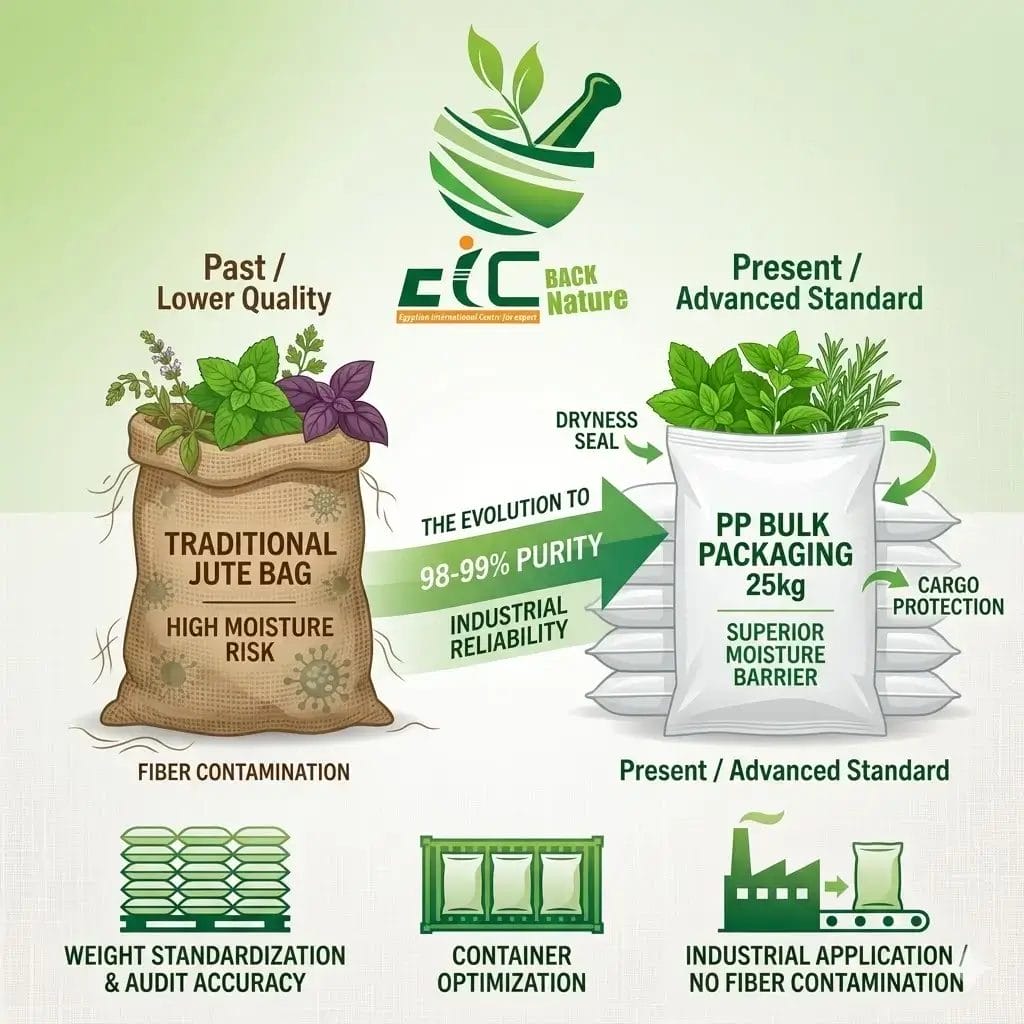
In the global trade of medicinal and aromatic plants, the choice of containment is a critical variable that determines the final quality of the raw materials upon arrival. For procurement managers and food scientists, sourcing from Egyptian herb suppliers requires understanding how packaging affects the product’s transit shelf life and chemical stability. While traditional jute bags have a historical legacy in agribusiness, the modern demand for 98-99% purity and rigorous international food safety standards has shifted the industry benchmark toward advanced 25kg bulk packaging solutions. At Egyptian International Center for export, we prioritize structural integrity and microbial defense, utilizing high-density Polypropylene (PP) bags to ensure our botanical exports survive the rigors of long-distance maritime transit without compromise.
The Evolution of Bulk Packaging 25kg in Agribusiness
Historically, the botanical trade relied on natural fibers like jute. However, as agribusiness exports transitioned into highly regulated sectors—including pharmaceuticals and cosmetics—the limitations of natural fibers became apparent. Modern Egyptian herb suppliers now lean toward industrial bulk bags that offer superior protection against environmental contaminants.
The shift toward bulk packaging of 25kg as a standardized unit is driven by:
- Ease of Handling: 25kg is the ergonomic standard for manual and semi-automated unloading at manufacturing facilities.
- Weight Standardization: It allows for precise inventory accounting and eliminates the discrepancies often found with variable-weight natural sacks.
- Container Optimization: Standardized dimensions allow for tighter packing within a 20ft or 40ft container, reducing movement during transit.
Why PP Bags are Superior for Moisture Barrier and Cargo Protection
The primary enemy of any wholesale botanical shipment is moisture. During sea transit, containers undergo extreme temperature shifts, leading to internal condensation. Without an effective moisture barrier, dried herbs can absorb moisture, leading to mold growth and the loss of volatile oils.
Superior Moisture Barrier Properties
Unlike jute, which is highly porous and hydroscopic, synthetic industrial bulk bags act as a formidable moisture barrier. This is essential for maintaining the 98-99% purity of Egyptian peppermint, basil, or marjoram. When Egyptian herb suppliers utilize laminated or high-density PP, they effectively isolate the herbs from the ambient humidity of the container, ensuring the product remains “bone-dry” from the Port of Alexandria, or other ports, to the destination warehouse of Bulk packaging.
Mechanical Cargo Protection and Durability
Botanical exports are often fragile. Rubbed leaves and whole Plant Seeds can be pulverized if the packaging fails to provide structural support. PP bags offer higher tensile strength and are less prone to tearing compared to aged jute. This cargo protection ensures that the physical grade of the herb—whether “fine cut” or “whole”—remains consistent with the pre-shipment sample.
Weight Standardization and Industrial Application
For a food scientist or production manager, the ability to dump a bag directly into a processing line without re-weighing is a significant operational advantage. Weight standardization at 25kg streamlines the industrial application of raw materials.
- Audit Accuracy: 25kg bags make it simple for quality control teams to perform “grab tests” and verify batch consistency.
- Reduced Waste: Synthetic bags do not shed fibers. One of the major drawbacks of jute is the shedding of natural fibers into the product, which can be flagged during quality assurance as foreign matter. By using clean bulk packaging 25kg, we eliminate fiber contamination.
Quality Assurance in the Bulk packaging Process
At the Egyptian International Center for Export, our commitment to a reliable supply chain begins at the bagging station. Packaging is the final step in our direct sourcing model, where the purity of the crop is locked in.
Our quality assurance protocols for packaging include:
- Liner Integration: For highly aromatic seeds, we often use food-grade inner liners to prevent the escape of essential oils.
- UV Protection: PP bags are treated to withstand UV exposure during loading, preventing the degradation of the plastic and the herbs inside.
- Secure Sealing: Automated stitching ensures that the bags are tamper-evident and hermetically sound for wholesale botanical trade.
By focusing on these technical details, Egyptian herb suppliers can guarantee that the international food safety standards are upheld throughout the entire voyage.
Direct Sourcing: The Advantage of Integrated Packaging
When you engage in direct sourcing with the Egyptian International Center for export, you eliminate the risks associated with third-party repackaging. Many brokers purchase in bulk and repackage in substandard conditions. We control the process from harvest to the final bulk packaging, 25kg seal. This ensures that the 98-99% purity achieved in our machine-cleaning facility is exactly what arrives at your door.
About the Company: Egyptian International Center for Export
The Egyptian International Center for Export, known in the global market as EIC for export, is a leading authority in the processing and export of Egyptian botanicals. For decades, the Egyptian International Center for Export has set the standard for quality in the Nile Delta region. Our expertise extends beyond cultivation into the science of logistics and preservation. By adopting advanced industrial bulk bags and rigorous weight standardization, we provide our global partners with a reliable supply chain that minimizes risk and maximizes yield. Our reputation as premier Egyptian herb suppliers is built on a foundation of transparency, technical excellence, and an unwavering commitment to the integrity of the herbs we produce.
Conclusion: Investing in Bulk packaging Integrity
Choosing the right Egyptian herb suppliers involves more than just comparing crop prices; it involves evaluating the protective measures taken during transit. Bulk packaging 25kg in high-quality PP bags represents a significant upgrade over traditional methods, offering a superior moisture barrier and unmatched cargo protection. As the agribusiness exports sector continues to modernize, the “Alexandria Protocol” utilized by the Egyptian International Center for Export ensures that your raw materials are protected by the best industrial science available.
Secure your botanical supply chain with the experts.
Are you looking for a partner that understands the technical nuances of wholesale botanical packaging? Contact EIC for export today for a Wholesale Quote or to discuss a Strategic Partnership. Benefit from direct sourcing and the 98-99% purity standards that only the Egyptian International Center for export can provide.
Frequently Asked Questions (FAQ)
What is the standard weight for Bulk packaging herb bags?
In the international B2B market, the industry standard is bulk packaging of 25kg or 20kg. This weight is preferred by Egyptian herb suppliers and global importers alike because it optimizes container space, complies with international manual handling safety regulations, and simplifies weight standardization for industrial processing.
Are PP bags or jute bags better for moisture protection?
Polypropylene (PP) bags are significantly better than jute for moisture protection. Jute is a natural, porous fiber that attracts humidity, which can lead to mold and degradation. Synthetic PP bags provide a superior moisture barrier and cargo protection, ensuring that botanical exports maintain their 98-99% purity and essential oil content during long sea voyages.